
Sharkless Moats: Global Startups Facing an America and China AI World
Can global startups find edge?

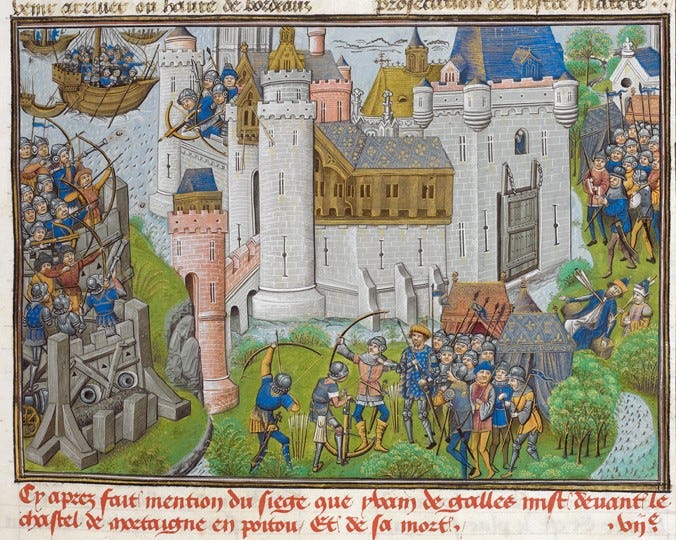
The Siege of the Castle of Mortagne, near Bordeaux, in 1377
“I’ve got one message to [business leaders], which is to widen the moat. And we want to throw crocodiles and sharks and everything else … into the moat to keep away competitors.” Warren Buffet, 2007 speech to University of Florida MBAs.
The question that matters
I continue to meet with astounding entrepreneurs globally – two or three a day, nearly 1,000 a year, from Singapore to Sao Paulo, and have turned my attention also to Europe (especially in Germany and Eastern Europe). Even in the go-go days I funded only a small percentage of them, maybe introduced a third to other investors more relevant to the entrepreneur. The rest left the call, I hope, with a few of my pointed questions that might be helpful.
For the last 18 months, however and especially at the earliest stages of venture, I have been back on my heels and almost funded nothing in these markets. And it’s about what for me is the most central question of AI and innovation in business building.
It is not that all entrepreneurs aren’t using it, because they are - massively and creatively.
It is finding what their moats are now and in the foreseeable future. And what might be swimming within them.
We have always had something of a gating question for investing in a startup whether a huge enterprise – say one of what today Jim Cramer calls the Magnificent Seven (Apple, Microsoft, Alphabet, Amazon, Nvidia, Meta, Tesla) or a Chinese equivalent – will use their size and scale to wipe a new comer out.
Not long ago, however, there were countless examples of large niches to work around or beat them. An Alphabet couldn’t do everything because giant operating companies require prioritization of resources - to unleash their core offerings, leverage new or large adjacencies, and harness the capital and physical execution required. New juggernauts were created.
This time it is different.
Today, I listen patiently to astounding entrepreneur pitches – with big problems they want to solve in their teeth and the kind of tenacity I’d have funded knowing they would figure it out even five years ago. But within 15 minutes, I find myself in every meeting asking, “Can’t Claude do this?” Today AI allows either a few people or massive players alike with little investment to do astounding things.
Are we in a moatless world?
We all come by our epiphanies on AI’s differences in our own ways. Back in January, I – a history major – built on Claude a small CRM that was pretty effective and wondered less why Salesforce stock was down over 40%.
When war began in Iran and Lebanon I spent a night, all night, building scenario analyses with the newest versions of each major LLM that had come out almost the same day. The accuracy and detail, even percentages on scenarios, were astounding (and as I was to learn astoundingly prescient). I shared the decks with friends recently serving or in governments and to a person they asked, “Who leaked this to you?”
But it was a young entrepreneur from Singapore building an AI experience for Asia around mental health that taught me there was as embedded moat in the LLMs themselves. Sadly, it offers yet one more challenge to entrepreneurial defenses: Relative impartiality.
It took me ten minutes to realize that her positive experiences in counselling were actually ChatGPT. When I asked her to assess why she preferred it to a human counselor, she didn’t blink: “Humans have a role, but I can’t call my counsellor at 2:00 AM, and ChatGPT never looks at its watch at minute 47.” She paused. “Also, I’ve become convinced in all my counselor experiences we are spending as much time working out THEIR shit as mine. AI has no shit…”
Last spring I met with the head of engineering for a manufacturing startup in Los Angeles who had previously headed a large team at Tesla. He noted that in those days he was able to attract the greatest engineers in the world, and they fought over creative answers, but at some point someone always said, “Well, when I was at Apple (or some other rock star engineering company) we did it this way!” He wondered at AI: “I use it all the time with a fraction of the people because it is never biased by one experience or has the ego to fall back on some big name to justify their argument over the facts.”
Are we all living in an America and China world – for now and the foreseeable future?
Likely.
As I reflect on my decade investing globally and especially in emerging markets, it is clear that the competitive advantages of “winners” there was to uniquely solve big, market specific inefficiencies by layering on tech; to offer services to millions who never had access to them before (e.g. banking) and unleash them; to offer mobility safely and affordable; to do so in local languages and customs; to navigate local political and regulatory machinations.
There is an argument that all of these – perhaps with the exception of regulation which I’ll come back to - are doable by a startup using AI or by the previous generation of juggernauts whose moats WILL increase due to AI with their massive unique data sets, large budgets, tech talent and near cost-free customer acquisition and/or upselling.
Does that mean let’s all buy stock in Mercado Libre, NuBank, Grab, and some American and Chinese juggernauts going after these markets and call it a day?
We must concede that at the LLM and infrastructure level, and in related areas like robotics and biotech, we are progressively living in an American and Chinese world. Not only the capital, chip and energy requirements demand a level of investment scale most cannot touch. Much of the greatest talent is hoovered up by them at exorbitant compensation packages. And it is their AI taking over the next generation of AI itself.
I don’t ignore efforts in the Gulf - shall we say somewhat distracted today (and I actually bet the UAE and others will be back.) I follow Mistral closely - it is impressive and for its competitiveness challenges France is a force in nuclear energy, and Europe has stepped faster than many expected into the AI-driven capabilities required for defense tech. ASML is a juggernaut. Defense tech globally and more broadly is learning from AI efforts in Ukraine.
But for the moment these exceptions prove the rule.
I asked a leader in India last fall if there will be a Deep Seek moment coming in India? The question startled him as if he had never thought of it. Maybe in some manufacturing; some argued in SMR’s; others space. But I found nothing convincing.
It is also clear to me that there will be no common ground and common efforts between America and China in AI technologically any time soon. This level of competition - viewed for national security reasons if nothing else as existential - does have a positive, which is the speed of astounding capabilities is guaranteed to accelerate and defy expectations as each tries to up the other.
Will China continue to catch up in hardware and chips, the greatest manufacturing and by far and away the lowest cost of energy while America keeps a software edge? Or the reverse? No one knows and for our thinking it doesn’t matter. As I wrote here, they will set their own rules and the world will be compelled to engage with them while finding edge elsewhere if not also opportunities for cooperation. American dynamism is hardly sitting on the side lines.
So, are there ANY moats anymore?
Maybe.
Certainly, the table stakes in any company boil down to their ability to explain, explicitly, what they are doing with AI and why and in service of what. Every company is an AI company - or so they will present themselves as such - but I cannot tell you how many talk a game, show a few mild efficiencies and really do not have a theory of a game or even track usage with metrics.
Another instructive question is to ask leaders how many of their employees blow through their tokens, how fast and where. Some companies require daily reports - which seems a bit much to me and can shift incentives - but usage tells an interesting tale.
One of the most interesting voices on moats, their possibilities and global ramifications is Uday Ghatikar, the Global Founder Advocate and Field Chief Technology Officer (CTO) at Google Cloud. Along with a twenty-year career at the cutting edge of AI, he runs Google Innovation Workshops and works closely with the Google for Startups Accelerator. Their Global Founder Advocacy team accelerate technical development with specialized AI architecture guidance, unlock Google’s extensive network and ecosystem resources, and directly amplify founder feedback to shape future Google Cloud product engineering. Suffice it to say, he knows something about building moats in new worlds.
It is one of those great coincidences in life that I just spent a couple of days with him having just read his must-read post on what stands in the way of great rising enterprises to focus on their moon shot potential: Moonshot Thinking in an Age of AI.
He told me he sees five key moats today – as instructive here at home as well as in the new global realities:
1) Leverage distribution history – trust, as they say, takes years to build and can be wiped out in a day. The depth of customer and partner connection, even in a coming world of agentic transactions, is hard to dislodge but also easy to ignore at your peril.
2) Lean into the customer experience of what they want, but also what and how they expect and associate with you. “For all my bias, my kids still want their iPhones and not Google Pixel phones!”
3) Find paths to verticalization – he called this a “tribal knowledge.” Once with a customer, there is an opportunity to go deeper and plant deeper roots in their partnership and expectations of you. This could be additional financial services or solving ever deeper compliance requirements or whatever adjacent problems you can engage.
4) Build large, unique data moats - what massive, unique data sets are you building and how does AI allow it’s leverage to be a moat? The juggernauts have this already horizontally, but rarely at the vertical level and depth in specific markets - the large private data of customer engagement and behavior that can revolutionize existing or new product development at ever decreasing CAC.
5) Seek being Switzerland – as larger players protect their internal competitive edge but require additional services they may or may not buy from each other but seek a more neutral third party. I thought of my friend Qasar Younis, co-founder and CEO of Applied Intuition which develops software platforms for physical AI and autonomy across the automotive, trucking, defense, mining, construction and agriculture industries.
This is a good list and to it, and in a global context, I would add two focusing questions, especially for rising markets:
First, what massive, hands dirty, physical problem still unsolved across specific geographic markets, especially emerging ones - say health, education, financial inclusion, movements of goods – was left unaddressed previously in Web 2/3 that AI makes this time different? Usage of AI certainly has moved across the elites in all our markets; but visit any city abroad and rural communities and opportunities at the physical level abound.
Second, what do governments want and are willing to support or defend? In many ways this is the most interesting to me. It is not new to have to navigate country by country, let alone through local regulations. It is not even new that some great brands - say Mercado Libre and Grab as examples - in many ways were deep down holding companies for many national versions.
But there is something new.
If Covid and war have taught us anything it is every country is rethinking supply chains and doesn’t want to over rely on others. Every country leader I meet does not want to be beholden to any other country for anything if they can avoid it. China, of course, is a leading example and has the scale to do this across almost any sector. But everyone is looking at their own version.
This is not a turning in or isolationism. It is prioritizing national ambition and ensuring there are national champions.
Sovereignty and unleashing national championship are a moat.
We have seen this in fintech and banking already. WhatsApp’s attempts of being a global payment provider hit the buzz saw of this in Brazil and elsewhere. Even NuBank has found challenges in moving to other countries in Latin America. Same in the areas of security. There was a time US Primes rolled across the world of national security. I doubt any defense tech star from America can do this now if there are local champions without partnering with them.
This is particularly true in these examples because they are in fields of a national government’s domain. It is navigable; but requires real work and local understanding on the ground.
And thus, is edge
For now.
What China reminds us
As I’ve written repeatedly, if one assumes we remain a massive, interconnected global economy, the bottom line is there is no better way to compete than to compete on the basics. Anyone – nation state or business – must fight to execute on the needs real people require in their daily lives; to have the most innovative technology to address those needs and extend solutions’ reach; to be in service of the most beautiful, customer service of making of goods and services at a fraction of the costs; to address bluntly and competitively if one’s country focuses as much or more on unleashing its potential than trying to merely slow others.
To end where I began with the wisdom of Warren Buffett:
What are they going to buy it on? They’re going to buy it based on service and cost. Most people will assume the service is fairly identical among companies, or close enough, so they’re going to do it on cost, so I gotta be the low-cost producer. That’s my moat. To the extent my costs get further lower than the other guy, I’ve thrown a couple of sharks into the moat.”
Chris, your second global focusing question is also most interesting to me. In a globally connected world of sovereign ambition to create national champions. how should nations think about a competitive policy response?
I would be interested to hear your experience on how different emerging nations are creating absolute advantages (sharks and draw bridges) for their champion’s moats with policies on effective tax rates, financing, regulations, and protectionism.
Great insights!
Thank you
Great post - TY Chris!!!!