
Beyond Decoupling: Friction, Interdependence, and Shared Horizons
Lessons from Recent Travel in China -- Shared AI Uncertainty, Kids' Futures, and the Opportunity Cost of Friction

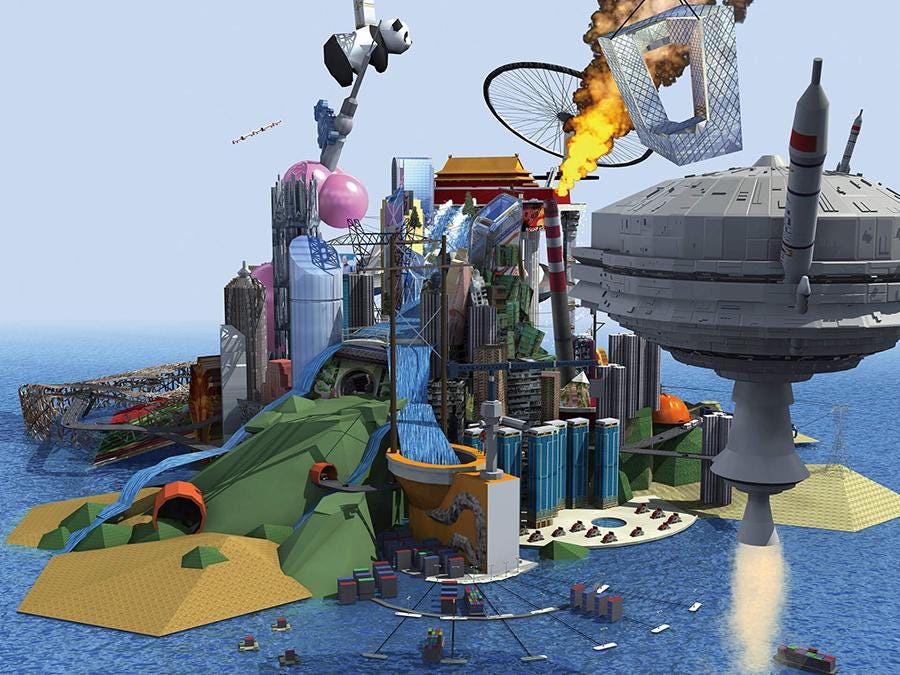
Cao Fei, RMB City: A Second Life City Planning, 2007
“I have learned that big top-down institutions like NGO’s and government agencies tend to think of people as problems to solve. We here in our plush office or state capital will solve you poor people. But the mindset of the bottom up – the very people on the ground with all real incentive to solve problems in their communities – think of people as assets to be unleashed.”
– Dina Sherif, Executive Director, The MIT Kuo Sharper Center for Prosperity and Entrepreneurship, in an interview with me in 2013
“When the data and the anecdotes disagree, the anecdotes are usually right. It’s usually not that the data is being miscollected. It’s usually that you’re not measuring the right thing.”
– Jeff Bezos, Lex Fridman podcast, December 14, 2023
“The cognitive orientations and skills of East Asians and people of European cultures are sufficiently different that it seems highly likely that they would complement and enrich one another in any given setting. We would expect that for most problems one would be better off having a mix of people from different cultures than having people who are from all one culture.”
— Richard Nisbett, The Geography of Thought (2003)
“When I venture down to the seafront, a hop and a skip from my home, I disappear into a moving portrait of this superbly colorful country. There are no social walls, no economic barriers to entry, no sectarian divides, no dress codes. The tiniest of Lebanons, and perhaps the most faithful reflection of the larger one. As I listen to chatter that fast-fades with my footsteps, I often find myself wondering, what do these good people want?
- Amal Ghandour, Senior Strategy Adviser Ruwwad, a regional community development initiative spanning Jordan, Palestine, Lebanon; Author, the blog “This Arab Life” May 9, 2026
* * * * * *
I returned to China two weeks ago, as a follow-on to my trip in November. I summarized my takeaways then in Parallel Universes: My Notes on China Beyond the Headlines, and much I saw and heard this time was consistent.
This time, like last November, I met senior executives “top down.” This included the C-suites of eCommerce, fin tech, drone and social media enterprises. I saw over a dozen early-stage companies in AI and robotics less in the Instagram “wow” videos of jumping androids but more solving challenges in agriculture, including pig farming, and manufacturing. I saw also traditional, large enterprises in health products and services – all rapidly deploying AI and robotics throughout their operations.
This time, like last November, there was unease about a struggling economy, rapid shifts in technology, and overall uncertainty more broadly. There remained a conviction that China could figure it out – at least “muddle through” – and that its greatest strength was its historic perseverance. America, strikingly, did not come up often unasked, in part because of political sensitives but mostly because the greatest challenges and opportunities remain at home.
At the same time, for all the tension and rhetoric and at least for now, a broader group worries and want something better between us. Even as China steers a path that allows it greater independence and rapidly lessening reliance on any one for anything outside its borders, every meeting I had at any level ended with a shrug and “Well, let’s see what happens in May in the Xi Trump meeting.”
We remain massive trading partners, many parents remain interested in American education for their kids, many major Chinese tech and traditional companies would love greater and creative win-win access to American markets. There was a lot of buzz there, as reported here, how the beloved social media app Xiaohongshu or RedNote could enter our market.
This time, I particularly focused on meeting people Dina called above “the bottom up.” Through translators and translation apps I moved away from the C-Suite. I spoke with DiDi drivers, workers at restaurants and tourism including people whose job was to physically carry tired people up mountain paths. I spoke with health care workers, large retailers, book store owners, flea market vendors and small shop keepers. I spoke with their Bong Bong men responsible for delivering products at all hours. I spoke with artists and writers.
What they said was strikingly similar. And what they said is strikingly familiar to Americans here at home wrestling similar questions.
“What kind of world should my kids and I be preparing for?”
One of the most surprising and surprisingly popular films in China right now is Dear You: Love Letters to Grandma, not yet available in America. The film revolves around an 88-year-old grandmother who spent decades waiting for her husband, who left for Thailand in the 1940s. Her grandson later travels to Thailand and uncovers a massive, beautiful secret: the husband died decades prior, and the letters and money she received were actually penned by another woman who quietly kept his promise alive for 18 years.
Audiences and critics on social platforms like Douban (where the film scored a rare 9.1 rating) point to several key reasons why this story struck such a deep chord. As a friend who has seen it twice agreed, the film felt like an antidote to “digital fatigue” in a modern world dominated by instant messaging, fast-paced short videos, and fleeting digital connections. “It meets a hunger for sincerity and realism from the big megahits. The actors are locals and help in a story-telling that makes us think about our cultural roots, something beyond AI.”
A hunger for sincerity and realism. Something beyond AI.
Many I met were a parent of a teenager or younger. To a person they were both curious and vexed by what they knew, or sensed, was a technology revolution in their midst. They all used AI regularly – including the American LLM’s – and were happy to access it. They love the seeming every increasing convenience that AI driven capabilities brought to their lives. Very few have been to a grocery store since covid as high-quality produce arrives reliably and cheaply. It is easy to send a package anywhere, overnight, for what in America would seem like pennies.
But the most common question I would then hear was: “But I have no idea what kind of future to prepare my kids for; what kind of life I hope they can have?”
I had lunch with a CEO and her team, and it was a perfect microcosm of this debate. She had long determined that her kids “were going to be normal kids.” In a world, especially hers, where high school students can literally be IN school 15 hours a day, she ends her kids school day at dinner. She encourages sports and arts; she encourages critical thinking.
She has no idea if they will do as well on the famous Gaokao exam – the two-three-day grueling nation-wide test whose score determine what college, if any, a student will attend. “I think they will get into a good school. But ten years from now I’m not even sure what traditional university will mean to their future. AI has changed everything. If I pound math, and computer science, and finance into them - is that even relevant? I figured the more creative they are; the more flexible and resilient the more prepared they will be.”
I looked over to the side, and one executive was clearly uncomfortable. My friend laughed and noted, “She disagrees.”
She looked at me directly in the eye: “In a world of massive uncertainty and competition, my kid can only be prepared if they go to the best university. Nothing is more important than that.”
Hidden behind this conversation is a broader, less discussed fear. According to one great China writer, suicide is the top killer of young people in China between 15 and 35. I spoke with parents from a top small private school, who whispered their concern here and stress levels overall.
Among younger people I met, there was a real hunger to connect with like-minded and like-experienced others in the uncertainty of our times.
As I have written previously, the massively and surprising best seller I Deliver Packages in Beijing – a memoir and reflection based on an equally massively and surprisingly popular blog – explored the life of a “gig worker.” In less than 20 years the author had nearly the same number of jobs – a package delivery courier; logistics night shift handler; bicycle salesman; digital and technical specialist and more. His stories are hard, sometimes funny and his reflections about work and the kind of life people aspire to very powerful.
Most young people I met had read it. Several teared up when I mentioned it. “In his book, I have re-read every page,” said one aspiring content creator. “It is the first time in current writing where I felt seen.”
I met several young people already proud to be “influencers” and have racked up large followings on their daily journeys. But I also met aspiring and serious film makers who want to tell the stories of their communities in order to understand and connect better with them. One created a stunningly beautiful, moving and well-edited short about a tattoo artist in Shanghai. She saved money from her salary in the travel industry to rent a decent camera and film editing software.
She posted it on RedNote – the hyper scaling platform blending elements of Instagram, Pinterest, and TikTok to let users share lifestyle content, product reviews, and travel tips while shopping directly. The comments are personal. They too underscore the desire to “be seen.” A senior executive at RedNote told me: “We see thousands of these regularly. Extremely high quality; wonderful story telling; people relating to their shared experiences. This is not just FOMO. It is a connectivity in shared experience and hopes.”
Seeking community and heritage. Navigating the uncertainty of our times, and new directions of technology. Worrying about children’s futures. Questioning what it means to be human and who and how we spend our times. Hoping my future and my family’s future can be better. A desire to be seen and find connection.
Sounds awfully familiar here at home in America. And in Europe. And everywhere.
For all our discussions about what divides us, for millions – billions – perhaps more connects us.
A friend and superbly successful businessman looked at me with bemusement and patience when I raised this: “Chris, we live in a world of power politics. No one gives a shit about any of this. We live in a world of billions and trillions of dollars and major shifts in trade and security. How would you tell any leader why this matters?”
I paused.
“I’d ask them upon what reasoning does this not matter. If this doesn’t matter, for what and who is power politics serving?”
“Why will you not admit we are already at war with China?”
I reflect on this question periodically, because I have been asked this in some form repeatedly.
At one level, I have a visceral pause when people use “war” as a catch-all for any problem that vexes us. “War on Drugs.” “War on Terrorism.” “War on Inflation.” “War on Cancer.” “War on AIDs.” “War on Poverty.” There are dozens of them throughout recent history.
When people discuss “winning the AI war” I almost know immediately they do not understand how technology works or how profound change is being unleashed right now. The Chapter 11 courts in America have been long filled with tech “winners” surpassed by the next thing.
The desire to rally people and resources to a problem is laudable. The batting average on any of these “wars” is something less than Hall of Fame.
I think, in fact, the analogy, while psychologically appealing, misses new realities and clouds much of the important nuance in which lies the true nature of the challenges.
Real wars have decisive outcomes. Real wars end. Most significant challenges – and opportunities -- we face combine ever changing and evolving circumstances, often with long historic and cultural foundations. They are all forever with us.
There is an understandable temptation to conflate the strategy and execution of China competitively with a steady and deliberate plan to replace America as a global hegemony. Reports on military and nuclear build up, spying, IP theft, fake news and more compound this.
How can it NOT be us versus them.
All of this may be true, and assuredly I hope and pray and assume in any pragmatic sense of real politik we are doing all this and more also. One of my favorite and provocative books a while back is by the Australian historian Geoffrey Blainey The Causes of War. In it, and with a look back at the last two centuries of war, he is persuasive that there is no better way to prevent war than convince someone they can’t win one.
But what if the framing is less us versus them, but us AND them.
What if the most likely scenario is not that one of us wins – “we win, they lose” as President Reagan famously once said – but we are all here. Strong defenses; constantly competing economically and technologically; constantly seeking our own interests. But also open to shared concerns that require and even welcome well proscribed engagement.
I was with a senior executive in the tech worlds in China, and asked them as I ask people regularly in my travels: “What do Americans most mis-understand about the ground here?”
He paused and noted: “Americans as they assess our economy – with all its many challenges right now and they are substantial – fail to understand how much the average Chinese out-saves Americans – like around 40% here to low single digits there.”
I had assumed this included significant money in real estate, where some research shows is off 30% or more in most major cities in China.
“Americans always get this wrong. We are not Egypt. Yes, people have savings in real estate, but I’m talking about bank deposits. When the consumer come back – and they will here – they will come roaring back.”
He paused again and said something I heard repeatedly during my trip in November and wrote about here.
“The only challenge in the short run is that we as a nation are focused less on the consumer spending now, and more about a very clear strategy to have the fastest, most advanced, highest quality, highest customer service, vastly lowest cost manufacturing of just about everything. Here’s another thing you miss – we have an energy strategy across capabilities from fossil fuels to solar to nuclear to have the lowest cost per kilowatt electricity to this end and to ensure we can lead in AI and robotics.”
He pauses one more time. “We do that, and the consumer will come. Covid, supply chains, your unpredictability. We have learned that no country wants to be overly reliant on anyone for anything. China, unlike most countries, has the scale and resources to achieve self-reliance.”
Self-reliance, by the way, does not mean isolationist. It is a statement of China wanting to call its own shots on their terms.
One interpretation could be that this is all in service of or an act of war preparation.
Another interpretation was stated by an American CEO friend with operations globally when I shared this story: “They are smart. We should have been doing this for years.”
As a senior official in Singapore said to me last year: “Have you all sometimes forgotten that the best way to compete is to compete?”
Are we giving as much attention to what obstacles hinder our competitiveness at home, and where there may be shared interests abroad?
“Here’s a contrarian question: can we build bridges in an era of burned bridges?”
There is nothing wooly headed in asking this question. In fact, most of the success I have experienced has been asking “why” when conventional wisdom has become conventional.
It came from one of the least wooly headed, most pragmatic, toughest and visionary executives I know who recently asked if we might find “informed engagement across borders.”
On the long plane ride back from China, I began to fuzzily recall a concept from my youth when I studied history of diplomacy in college. AI, of course, updated me a bit.
Legendary political scientists Robert Keohane and Joseph Nye in 1977 created a theory they called Complex Interdependence, arguing that modern superpowers are bound by much more than just the threat of nuclear annihilation. They showed that dense networks of economic, social, and technological ties create a reality where traditional military conflict causes severe mutual self-harm.
While their theory coming deep within the cold war and nuclear Mutual Assured Destruction (MAD) strategy of the time, there was less focus on the opportunities in the networks of economic and technological ties. In fact, those ties were a fraction of what they are now. But their observations remain provocative. And the differences in realities today instructive.
Here is an interesting mind exercise.
Let us say we assume there may never be “shared values” regarding governance or civil liberties.
Let us also assume that structural realities mean co-existence is not a soft, idealistic choice but simply the only choice. These include, but are not limited to, impenetrable militaries; relatively automated defense parity; unbreakable economic ties both between us and deeply intertwined through third-party countries and complex global supply networks; and global existential opportunities and challenges in health, natural disasters and uncertain ramifications of AI and Quantum.
Let us further assume that these are not only realities today but in any foreseeable future and thus should be the premise of our relationship rather than, say, Cold War and Thucydides Trap historical analogies and comparisons.
Let us add that in all this there may be areas outside of crises where engagement would not only help avoid them to begin with but unleash greater and measurable outcomes for all.
More precisely, what if we define this reality as 1) our military strength makes war very unappealing to each; 2) defense tech and autonomy offers a new MAD for conventional weapons; 3) China has set up manufacturing tech and low cost energy infrastructure that may or not be matchable but not over takeable; 4) “tech wars” don’t exist as each side will keep pushing the other to innovate; 5) shared “values” remain controversial, but there are huge shared interest to more than guardrails - in areas like health, job creation and loss; maximizing opportunities in – dare I suggest – space?
What if dialogue about such realities does not require details of competitive technological or military advantage, but about best practices and concrete deliverables for better societies.
Three examples:
Global Health - Pandemic prevention, biometric security, and drug supply chain stabilities rely on joint management but also open capabilities to, say, cure cancers more quickly.
Economic Stability - Automation and AI will bring untold opportunity and disrupt job markets in both nations; maximizing societal benefit while managing labor shocks requires stability and shared learning in service of both new opportunities and potential dislocations.
Space Exploration - As both nations build independent lunar bases, orbital traffic and rescue protocols demand rules but also the possibility of co-authorship to achieve goals faster.
Why wouldn’t we prioritize this in our strategic engagement as well?
Here at home, the political incentives remain with the binary analogies of win-lose. Politicians in both parties win votes by sounding tough, promising total economic independence, and threatening restrictions. The media incentives remain equally binary. It is easy to write a headline about a new EV tariff or an AI chip ban. It is much harder to write a headline about the millions of invisible, multi-layered supply chain connections that cannot actually be unwound.
China has its own political realities and incentives, of course, also.
And, of course, a litany of well documented actions and steps in the last decade which may simply as a whole or in part mean my assumptions scenario is beside the point. What if my friend’s chastisement is right, and none of this matters – it’s too late?
What if it isn’t?
Some pretty thoughtful people are turning their attention to these questions.
Washington being Washington and academics being academics, and all of us being creatures of habit and analogy, one friend used the term with me the other day, Mutual Assured Economic Destruction (MAED).
They point out that after years of escalating trade tensions, both Washington and Beijing have finally mapped out each other’s economic pressure points. They realize that triggering a full economic break would instantly cause catastrophic, reciprocal domestic failures.
Beyond closed doors and outside of social media I hear more and more such discussions happening. Some have told me in the last summit while nothing concrete came – and invariably most pundits focused more on “who won” – tone matters. And, at least for a moment, there was a different tone. A different tone has meaning.
Let’s see what happens in September.
* * * * *
I have found that travel has a way of stripping away the grand, abstract theories of geopolitics and business I too often gravitate towards, leaving me with better ground-level realities that actually dictate daily life. If nothing else, it makes my questions better.
Whether navigating the immediate anxieties of how AI will shift our workplaces or discussing what kind of future we are leaving for our kids, the core concerns in both the US and China look remarkably similar to me. And they do matter. And they may instruct our premises and push us to rethink our assumptions.
For what and for whom is power politics serving?
I continue a journey in digging deeply in the Tang Dynasty period of China in the 7th to 10th centuries. This period is particularly interesting for today because it was one of the greatest, most forward-thinking, creative, and globally embracing societies in history. And yet, in a few decades it also astoundingly quickly fell into anarchy and collapse that may have cost a catastrophic population loss that census records suggest cost up to 30 million lives.
In a few decades.
It is no surprise that some of the greatest art and poetry in the world came from such a time. My favorite, and that of millions, remains Du Fu.
In 748 what he wrote in Twenty-two Rhymes Respectfully Presented to Vice-Director of the Left, Senior Wei addresses this question head on:
“To guide the sovereign to surpass the golden ages of the ancient sage-kings, and to restore the nation’s societal fabric to harmony and abundance.”
Ultimately, governance isn’t an ideological competition – though everything in our political existence and certainly in social media tells us otherwise. It’s a practical tool for solving human problems and unleashing human potential.
If this is enhanced with, separate from or in opposition to China is matter for the leadership of both countries. But it is a choice, not an inevitability.
And there are creative scenarios with clearer assumptions based on a very different time.
This is a very valuable framing because it moves the discussion beyond the lazy binary of decoupling versus engagement.
What is emerging between the United States and China is better understood as frictional interdependence: two systems that increasingly distrust each other, compete across technology and industrial capacity, and yet remain deeply entangled through supply chains, markets, talent, capital, standards, and third-country networks.
The important point is that China’s push for self-reliance should not be read simply as isolation. It is closer to a strategy of strategic optionality: building enough industrial, technological, and energy-system depth to avoid being coerced, while still remaining connected to the global economy where connection serves Chinese interests.
This is also why the “war” metaphor is misleading. Wars imply a decisive end state. But the U.S.-China relationship is likely to be a long condition rather than a single event: managed rivalry, selective cooperation, technological competition, and continuous adjustment.
The real challenge is whether both sides can develop institutions, language, and strategic discipline capable of managing interdependence under high political friction.
Important observations and insights on what remains the defining story of our age, with due regard for technological innovations and disruption. Whether and how the U.S. and China navigate the next few years (as opposed to continuing down the current primary path, which is anything but “navigation”) will have something significant to do with alleviating our common parental laments — that foreboding feeling when reflecting on our children’s’ futures (well shared in this post). What I really love about this one, Chris, is you go to the BIG questions … I will re-read it.